
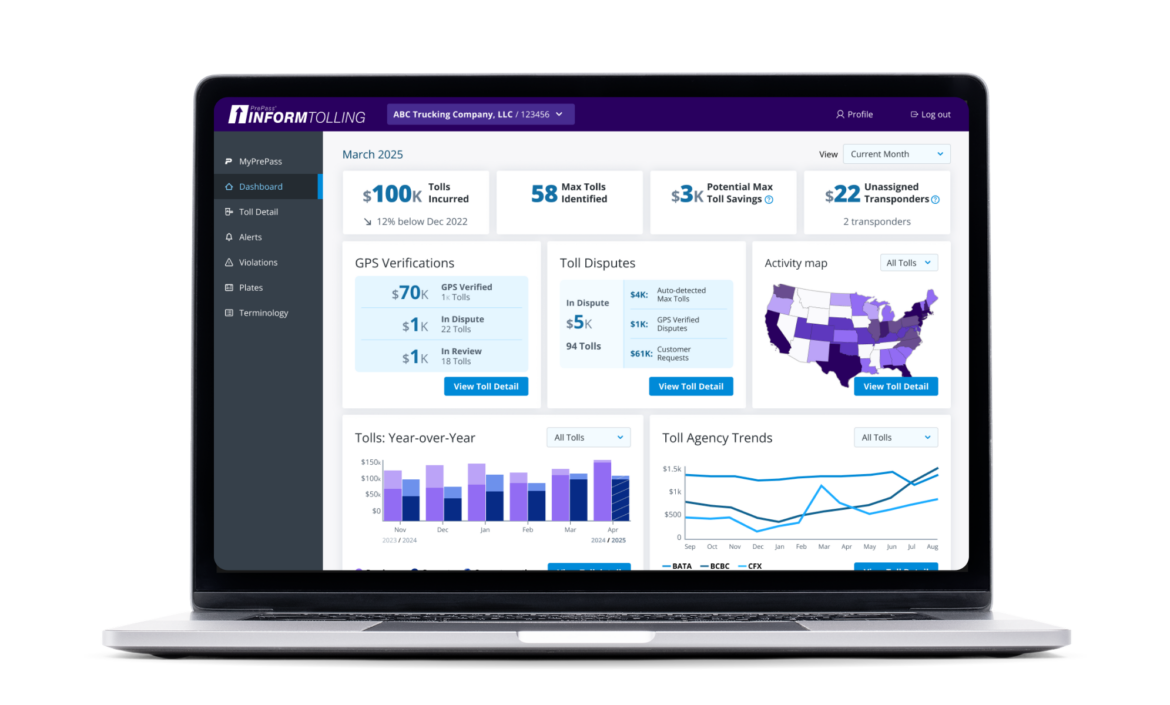
Fleet tolls used to be something managers accepted as unavoidable: a complex maze of invoices, inconsistent charges, and endless spreadsheets. Today, those days are quickly fading. With powerful toll dashboards and GPS verification tools, fleets can now track, validate, and optimize toll spend with precision that was once impossible.
These next-generation tools are not just improving toll accuracy; they’re transforming how fleets make data-driven decisions about routes, costs, and performance. And leading that transformation is PrePass’s Toll Management solution, which empowers fleets with innovative systems like INFORM™ Tolling and GPS toll verification.
Let’s dive into how these modern technologies are changing the game for fleet managers everywhere.
Why toll management is due for innovation
Tolling used to be a reactive process. Fleets would receive invoices weeks later, with little visibility into where or why costs fluctuated. Manual audits and limited integration made it difficult to detect overcharges, especially when vehicles crossed multiple tolling authorities.
But the industry has evolved. As digital toll networks expand and fleets grow more data-driven, the need for accurate, centralized, and actionable toll information has become essential.
Modern fleets now expect their toll data to:
- Sync seamlessly with dispatch and accounting systems
- Help identify toll overpayments or misclassifications
- Provide clear dashboards for expense reporting
- Support strategic routing decisions
PrePass recognized this shift early and developed a suite of tools to make toll management simpler, smarter, and more transparent.
The evolution of toll calculation technology
For decades, tolling relied on transponders and plate reads alone. While these systems are still vital, the next evolution lies in combining toll data with GPS-based verification and intelligent dashboards that give fleet managers a holistic view of toll activity.
This isn’t just about tracking. It’s about empowering fleets to understand how toll costs occur, where they happen most frequently, and what can be done to optimize spending.
PrePass’s approach integrates toll data from multiple sources, validates it with GPS coordinates, and presents it visually through INFORM™ Tolls dashboards, creating a single source of truth for fleet operators.
Understanding INFORM™ Tolls
INFORM™ Tolls is a powerful data analytics platform that simplifies toll oversight for fleet managers. Rather than digging through invoices or spreadsheets, INFORM™ presents toll performance data in intuitive dashboards designed for actionable insights.
Key capabilities include:
- Detailed toll spend visibility across vehicles, routes, and timeframes
- Identification of toll discrepancies and duplicate charges
- Insights into which regions or routes drive the highest costs
- Exportable reports for financial and operational teams
In simple terms, INFORM™ turns what used to be a tedious back-office chore into a strategic advantage.
How toll dashboards drive smarter decision-making
Toll dashboards give fleet managers the clarity they need to make data-backed choices every day. Instead of reactive problem-solving, they can proactively manage toll costs.
Better visibility, better control
Dashboards allow you to see toll activity by route, driver, and vehicle class in one place. This helps uncover patterns like a specific route that consistently triggers higher tolls or vehicles that may not be properly classified.
Simplified reconciliation
With toll transactions automatically organized, invoice validation becomes far easier. Managers can cross-reference charges against GPS data or trip logs in minutes, not hours.
Actionable analytics
Dashboards don’t just display data…they tell a story. Fleet leaders can identify cost outliers, forecast future toll spend, and evaluate whether route changes or transponder adjustments might yield savings.
In short, toll dashboards transform your toll management from guesswork into a measurable, optimizable process.
The power of GPS toll verification
Even the most advanced toll systems can make mistakes. A misread transponder or an unregistered plate can lead to “max toll” charges that add up fast. GPS toll verification acts as a safeguard—confirming that every toll charge aligns with a vehicle’s actual location data.
How GPS verification works
When a toll is charged, the system compares it against GPS trip data from the vehicle. If a toll agency records a charge for a toll plaza your truck never passed, the discrepancy is flagged for review.
Why this matters
- Detects incorrect or duplicate toll charges
- Prevents payment of inflated “max toll” rates
- Protects against tolling authority errors
- Builds trust in your toll data
By validating toll events against verified GPS data, fleets can confidently pay what they owe—and nothing more.
Combining dashboards and GPS: a new standard in toll accuracy
The real magic happens when dashboards and GPS verification work together. GPS ensures data accuracy, while dashboards turn that data into insight.
Benefits of combining both systems
| Feature | Toll Dashboards | GPS Verification | Combined Impact |
| Visibility | Centralized toll spend by route and vehicle | Confirms each toll event’s accuracy | Transparent, verifiable toll oversight |
| Efficiency | Faster invoice reconciliation | Flags errors instantly | Saves time on audits and dispute resolution |
| Strategy | Identifies high-cost routes | Ensures correct toll attribution | Enables smarter route and cost decisions |
PrePass integrates these technologies into a seamless experience that eliminates guesswork and boosts financial accuracy across your fleet.
Reducing toll disputes and back-office workload
Manual toll auditing used to take entire teams. With automation and GPS-backed verification, that workload drops significantly.
How automation helps
- Eliminates repetitive spreadsheet matching
- Flags anomalies automatically
- Streamlines dispute submissions with supporting GPS evidence
The result
Fleet accounting and operations teams spend less time validating tolls and more time optimizing operations. PrePass’s INFORM™ tools are designed precisely for that purpose—reducing administrative drag while improving accuracy.
Supporting compliance and cost transparency
As toll networks expand across North America, compliance and recordkeeping become increasingly complex. Dashboards and GPS verification simplify this burden.
By consolidating toll transactions into one digital platform, fleet managers can easily demonstrate compliance with IFTA reporting, tax documentation, and internal audit requirements.
This level of transparency also strengthens trust between operations, accounting, and customers who depend on accurate billing.
Turning toll data into financial intelligence
Your toll data is more than a record of transactions—it’s a financial intelligence asset.
By analyzing toll spend by lane, region, and vehicle type, fleets can uncover opportunities for cost reduction. For example:
- Adjusting routes to avoid consistently high-cost tolls
- Reallocating transponders to higher-traffic corridors
- Identifying underperforming routes or drivers incurring extra tolls
PrePass’s data-rich dashboards turn these possibilities into tangible strategies, driving continuous improvement.
Scaling cost savings across the fleet
Once you have a handle on toll visibility, scaling those savings across hundreds or thousands of vehicles becomes achievable.
Dashboards enable comparative reporting, so you can:
- Benchmark performance across terminals
- Share insights fleetwide
- Standardize best practices for toll optimization
This approach leads to consistent savings at scale: a hallmark of data-driven fleet management.
Security and data accuracy you can trust
With the integration of GPS and tolling data, data privacy and accuracy are paramount. PrePass’s systems are designed to meet the highest data security standards, ensuring sensitive fleet information remains protected.
Every toll record is validated through secure data channels, ensuring accuracy without compromising confidentiality.
The role of automation in future toll management
As technology advances, automation will continue to drive efficiency in toll management. Future systems will rely on predictive algorithms to forecast toll exposure and recommend cost-efficient routes in advance.
PrePass’s commitment to innovation ensures fleets stay ahead of these trends, adopting tools that deliver real-world results today while preparing for tomorrow’s advancements.
Why modern toll tools are a competitive advantage
In an industry where every dollar counts, having clear, accurate toll data is a distinct advantage. Fleets using PrePass’s toll dashboards and GPS verification tools gain:
- Greater cost predictability
- Streamlined operations
- Better financial accountability
- A stronger competitive position
Toll accuracy isn’t just an operational upgrade—it’s a strategic edge.
Conclusion
Toll management has evolved from a reactive process into a proactive strategy powered by data. Toll dashboards and GPS verification tools give fleets the control they need to cut waste, validate accuracy, and scale savings efficiently.
PrePass is at the forefront of this transformation, combining sophisticated analytics, GPS validation, and automation into one seamless platform that simplifies toll oversight for fleets of all sizes.
To explore how these tools can modernize your fleet’s toll management process, visit PrePass Toll Management.
FAQs
1. What is a toll dashboard?
A toll dashboard is a digital interface that consolidates all toll transactions, helping fleet managers track costs by route, vehicle, and time period in one place.
2. How does GPS toll verification work?
It cross-checks toll charges with vehicle GPS data to confirm whether the vehicle actually passed through a tolling point to flag any discrepancies automatically.
3. Why do fleets need toll dashboards and GPS tools together?
Dashboards provide insight while GPS ensures accuracy. Together, they give fleets confidence in every toll transaction and simplify audits and disputes.
4. How does PrePass’s INFORM™ Tolls help fleets?
It visualizes toll data, highlights cost trends, and identifies errors, allowing fleet managers to take control of their toll spend proactively.
5. Can these tools integrate with other fleet systems?
Yes. Toll data can often be exported or integrated into dispatch, accounting, and telematics platforms for a unified view of fleet costs.
6. What kind of savings can fleets expect?
Savings vary, but fleets that implement dashboards and GPS verification typically reduce overcharges, administrative costs, and toll disputes…often cutting toll expenses by 10–20%.
External Reference:
For additional reading on how GPS-based analytics are shaping transportation logistics, visit American Transportation Research Institute – The Impact of Emerging Technologies on Freight Efficiency.
